
Overstory and Fulcrum partner to close the loop between risk planning and field work
The new integration gives utilities a live view of risk, a clear path to act on it, and a defensible record of the work’s impact
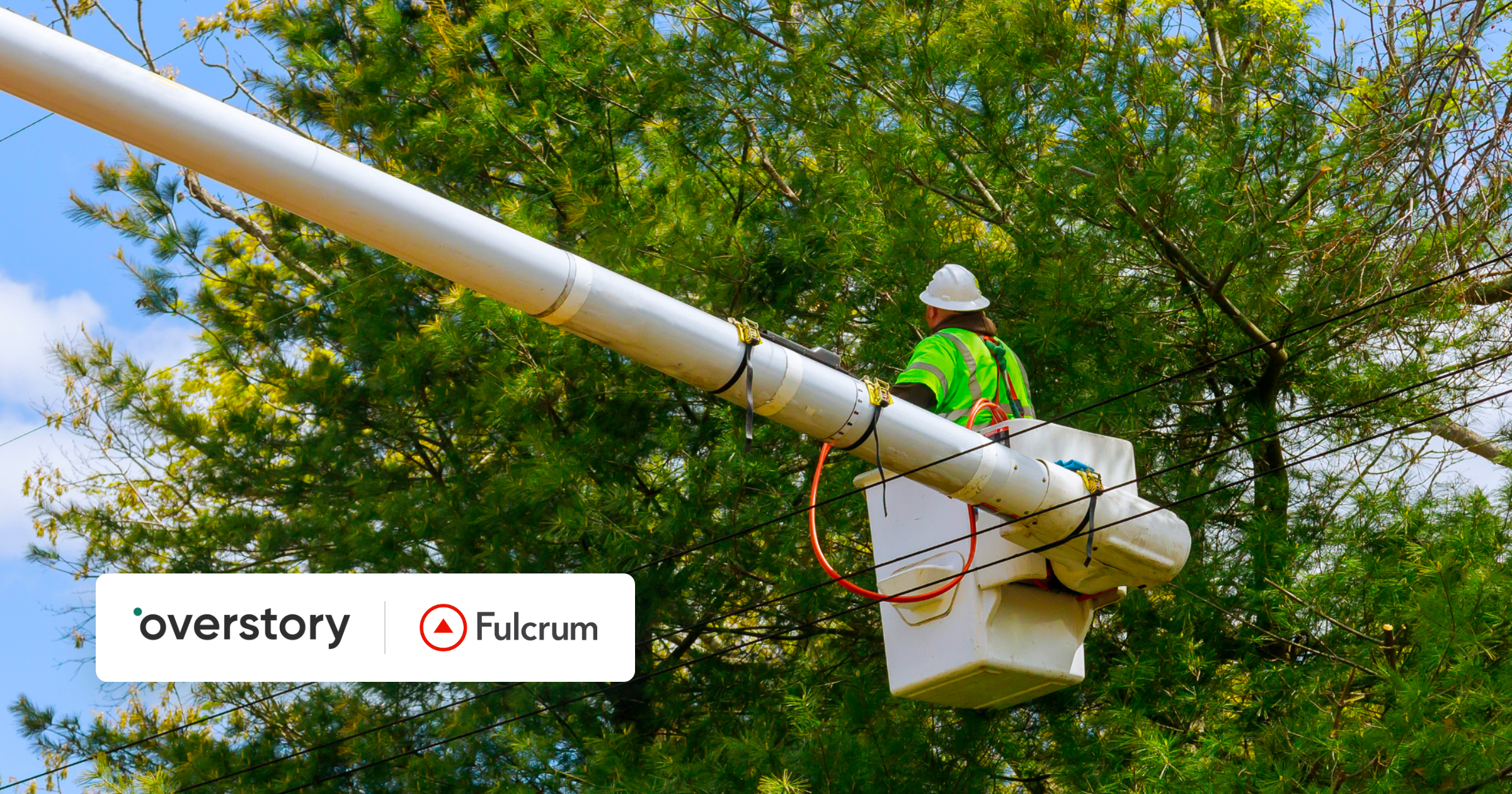
The integration connects risk planning in Overstory to verified field work in Fulcrum.
September 29, 2026
Key points
Overstory's new integration with Fulcrum sends risk-based work plans straight to field crews and syncs completed work back to Overstory.
Utilities get a verified record of the risk their work removed, not just the work their crews completed.
The integration is the latest step in connecting Overstory to the tools utilities already use.
Overstory and Fulcrum today announced a partnership that gives utilities a live view of where risk exists across their network and a verified record of the risk their work removed.
Utilities have long reported vegetation management in miles trimmed, trees removed, and inspections completed. While those metrics show the work that’s been done, they don't measure the outage or ignition risk that work removed. As affordability pressures grow, regulators expect evidence behind every expense, down to how much risk each mitigation program bought down.
The integration between Overstory and Fulcrum closes that gap. When crews complete a job in Fulcrum, the risk profile in Overstory is updated, enabling utilities to answer three key questions. Where does risk exist today? What risk have we reduced? Where should we act next?
The gap between planned work and proven results
Vegetation is among the leading causes of distribution outages in North America, and in fire-prone territory the same trees and fuels drive ignition risk. Utilities spend an estimated $8 billion a year on vegetation management.
A utility’s vegetation plan typically starts in GIS or planning software, goes to crews and contractors as a spreadsheet or emailed work package, and detailed work is captured in a separate work order management system. Matching those records to the plan is highly manual, and along the way, each finished job loses its link to the risk-based planning that justified it.
"Utilities are under immense pressure to prove the impact of their work, but disconnected systems make that nearly impossible," said Fiona Spruill, CEO of Overstory. "By connecting Overstory and Fulcrum, utilities will have a live, defensible record of where work needs to happen, what's been done, and what impact it's had, building trust with local communities and regulators."
How the integration works: from risk to work order to record
The integration follows each piece of work from planning to the field and back.
Plan in Overstory. A utility builds a program by analyzing the risk it wants to address across a network, such as priority circuits with high encroachment or strike risk. They can project the program's expected impact on vegetation-caused SAIDI (System Average Interruption Duration Index, the average outage time per customer), its estimated cost, and the total project scope. Programs can be compared side by side, and stored as a repository of programs reflecting various scenarios.
Execute in Fulcrum. With one sync, every program generates a work order in Fulcrum under the same program name. As work progresses, every step is tracked with notes and photos along the way. The work can be logged without cell signal, and records sync once the device is back in coverage.
Prove it in Overstory. Completed work syncs back to Overstory, where programs are updated to reflect the work that’s been done and what remains.
Across Overstory and Fulcrum, spans share the same identifying information, so no one has to reconcile crew reports against the plan by hand.
The demo below follows a utility’s mid-cycle canyon winds program, from targeting high-risk spans in Overstory to completed work in Fulcrum and the risk the program bought down.
Evidence for planners, executives, and regulators
Together, Overstory and Fulcrum provide a unified record for the stakeholders who plan, fund, and review the work.
Vegetation managers see what work is complete, what remains, and how the program has reduced risk, span by span. Executives get cost, spend efficiency, and remaining risk from one record instead of separate reports. And regulators receive a span-level record that ties program cost to the risk the work removed, as evidence for a rate case or wildfire mitigation plan. Conditions that crews observe on the ground also feed back into Overstory, helping utilities better predict risk over time.
"Fulcrum's integration with Overstory shows field crews where they need to go and what they need to do," said Jim Grady, CEO of Fulcrum. "As they work, Fulcrum's integrated safety and field-process capabilities capture the auditable data that proves they lowered risk. That record then feeds straight back to Overstory to update the risk picture."
Connecting the wider utility ecosystem
Utilities run numerous specialized systems for weather, vegetation, assets, and field work. Disconnected, these systems tell only part of the story. Overstory is built to connect with the tools utilities already rely on, from remote sensing providers to weather models to field operations platforms like Fulcrum, to create a living model of nature and network for utilities and the communities they serve. Fulcrum joins Watch Duty as the latest partner in that effort.
The integration is available now for utilities partnering with Overstory or Fulcrum. Book a demo to see it in action, or read how utilities deploy vegetation intelligence in our playbook, Operationalizing Advanced Vegetation Intelligence.
