Introducing Overstory's grid risk management platform
The integrated platform helping utilities prevent outages, prepare for storms, and stop catastrophic wildfires.
Overstory introduced the industry’s first AI models to help utilities predict where outages and wildfires are mostly likely to start. These models are used by the largest utilities across North America to identify the trees that could strike a power line and the ground fuels that could cause a spark to spread into a wildfire.
Today, we’re launching our new grid risk management platform to integrate those models directly into the core data and systems utilities rely on. This platform helps utilities keep communities safe by anticipating threats, modeling treatments, and sending priority work to crews in the field.
The missing lens on nature, and what it costs utilities
The greatest grid risks exist where nature meets network
The grid was built on a simple premise: build assets to carry power for generations, and maintain them on predictable, cyclical rotations. For half a century, that steady rhythm of grid resilience worked. It worked because weather and climate patterns stayed within historic ranges.
Those patterns have dramatically shifted. According to the International Energy Agency, in many regions of the world, extreme weather is now the primary threat to grid reliability, with weather-related outages rising roughly 78% over the last decade. Severe heat and drought are lengthening fire seasons from southern Europe to the American Southeast and beyond. As we enter into a new era of extremes, managing grid risk requires a radically different approach.
While utilities know their networks incredibly well, they struggle to understand the fast-moving world that surrounds it.
Utilities have a wide range of data but no integrated view of which risks to act on first
To close that gap, utilities have brought in wildfire experts, in-house meteorologists, and certified foresters, and invested heavily in new technologies and data sources, from fast-trip protective devices to satellite imagery, LiDAR, and sensor feeds.
Despite having all the pieces, they can’t see the whole picture. Critical information remains trapped in silos: poles and lines live in GIS platforms, weather streams into simulation models, and work orders route separately to crews in the field.
Unifying these fragmented systems is difficult enough; turning that unified data into timely action is harder still.
A restoration crew needs to know not just where a storm will hit, but where outages are most likely and how many customers would lose power. A vegetation manager with a high-resolution view of their network must decide where next year's budget will remove the most risk. These decisions depend on how vegetation, fuels, and weather interact with the network, and very few utilities can see that interaction holistically.
With rising risk and tighter budgets, utilities must defend every investment
All of this risk compounds as demand for power surges and rates climb. Growing affordability concerns are driving regulators to demand clear evidence of prudent spending in every rate case. In California, utilities are required to report on risk spend efficiency for every mitigation they propose to regulators. Utilities can no longer defend budgets with estimated work to be done. They must prove exactly how much risk each dollar will reduce.
Overstory: One living model of nature and network
Overstory’s grid risk management platform is built around the closed loop that utilities need, from conditions across the network to work completed in the field:
- Physical. Overstory aggregates satellite and aerial imagery, LiDAR, and weather data to create a complete picture of nature and network, with trees, fuels, weather forecasts, and terrain around the lines mapped alongside the assets they threaten.
- Predictive. Based on the physical picture of the network, Overstory estimates where outages and ignitions are most likely to start, how that likelihood shifts as weather and vegetation change, and the potential impact on customers, spanning vegetation, wildfire, and storm risk.
- Prescriptive. Operators can model tradeoffs between what each mitigation option would cost and how much risk it would remove, whether the work is trimming, fuels treatment, hardening, or asset replacement.
- Operational. Work is delivered through the systems that planners, crews, and responders already use. Through a partnership with Watch Duty, Overstory’s vegetation risk data appears alongside live wildfire alerts. Overstory is also integrated with Fulcrum to bring prioritized work into the field apps crews use to plan and document it.
- Measurable. Completed work flows back into the Overstory platform, so a utility can show regulators and executives how much risk each dollar has removed. Overstory’s predictions sharpen with each input from the field.
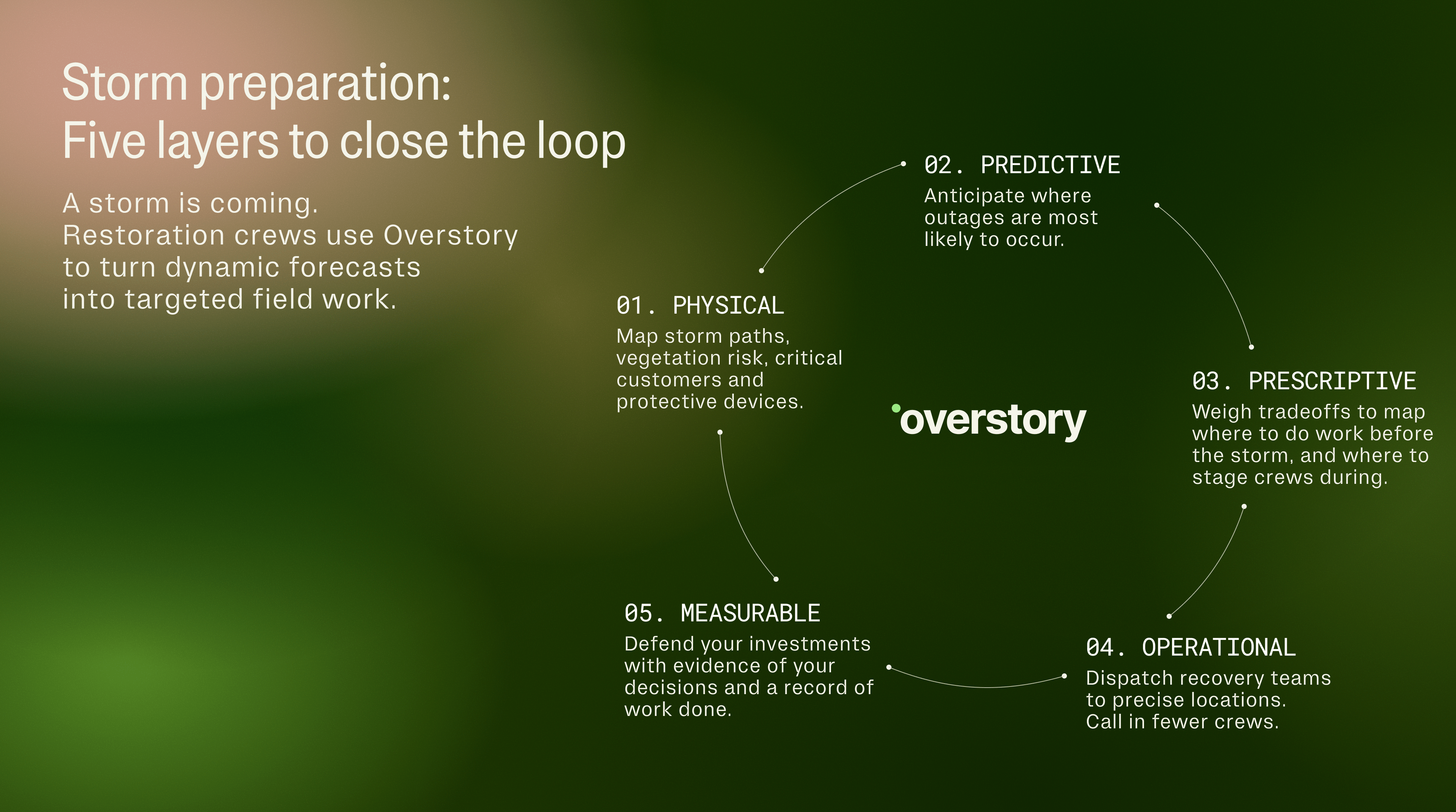
A prediction is only as good as the physical picture beneath it, and a prescription changes nothing until crews carry it out and the results come back. With Overstory’s grid risk management platform, a utility can build an evidence record of conditions, actions, and outcomes that holds up in front of regulators.
The whole picture of grid risk, built into your systems
Utility leaders want to manage compounding grid risk from one view rather than through disparate programs and datasets. Overstory is the grid risk management platform built for this shift. It connects to the systems utilities already rely on, so a vegetation planner, a wildfire lead, and a storm crew can work from the same view of risk and act on the same priorities.
A strong El Niño is forecast to last into early 2027, and next year’s plans and budgets are taking shape now. Build them on the whole picture of how nature meets your network.
Related content



See the risks.
Change what happens next.
Learn how you can direct every dollar to the work that matters most.