
Federal wildfire policy and the Fix Our Forests Act: what would change for utility rights-of-way
Notes from Western Caucus Wildfire Week 2026
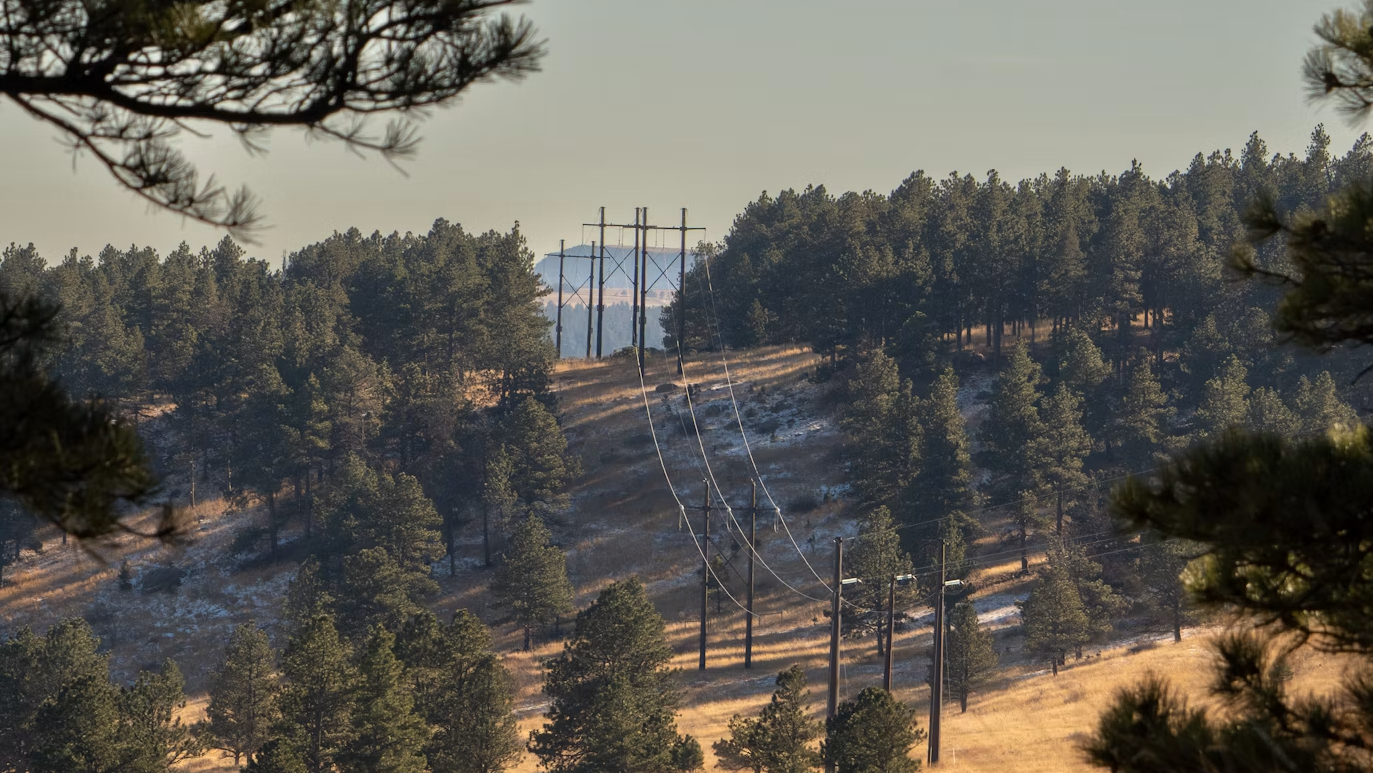
Utility rights-of-way crossing federal forest land sit at the center of the permitting provisions in the Fix Our Forests Act.
In September 2026, members of Congress convened with firefighters, forestry leaders, major utilities, and technology experts, including team members from Overstory, for Western Caucus Wildfire Week to review where policy stands and new approaches to reducing wildfire risk on federal lands.
The week came with the Fix Our Forests Act (FOFA) still awaiting a Senate floor vote after passing the House in January 2025. For utilities with power lines crossing federal land, the bill would shorten the path to fuels work and hazard-tree removal that is already budgeted and, in many cases, already committed to state regulators.
Karim Al-Khafaji, Head of Business Development at Overstory, and Ross Davison, Overstory's Director of Wildfire Solutions and Partnerships, demoed Overstory's Wildfire Intelligence at the week's Wildfire Tech Expo, focusing on federal lands and wildland-urban interface (WUI) corridors, where homes and communities meet undeveloped wildland vegetation.
Overstory last engaged federal regulators on wildfire in October 2025, when Karim testified at FERC's Wildfire Risk Mitigation Technical Conference. Where FERC focused on transmission compliance, Western Caucus approached wildfire from the response side, with much of the formal program centered on firefighter safety and better insight into active fires for ground crews.
Below is a breakdown of where U.S. federal wildfire policy currently stands for utilities, what FOFA would change for rights-of-way on federal land, and how to measure which mitigation work reduces the most risk.
Three tiers of federal wildfire attention
For utilities, federal wildfire policy falls into three tiers, each at a different stage of the legislative process.
Federal response capability is settled
Funding federal wildfire response is no longer an annual appropriations fight. Utilities do not employ firefighters, and many of the rural areas they serve have neither large nor well-equipped local response forces, so the federal government remains best positioned to move personnel, equipment, and aircraft across state lines. The open questions now concern sustaining that workforce, including housing support for firefighters in high-risk communities and continued backing for cross-state cooperation agreements.
Forest health and fuels work is moving
Prescribed burns, fuels reduction, and post-fire restoration have momentum, and the debate has narrowed from whether to treat federal forests to how much and how quickly.
For utility vegetation management teams, these policy trends may seem distant, since federal forest policy governs land the utility does not own. But forest conditions beyond the right-of-way drive risk inside it. Holy Cross Energy in western Colorado, for example, used Overstory to identify beetle kill areas adjacent to its network for that reason. Many vegetation management programs run on multi-year trim cycles, but drought, heat, and beetle infestations can weaken or kill trees between cycles, conditions sometimes called cycle busters.
FOFA would speed up that work on federal land by designating high-risk firesheds for treatment and shortening environmental review for fuels projects, including those alongside utility corridors.
Liability and insurance have no vehicle
While much of wildfire risk grows outside a utility’s right-of-way, they are held liable for it. Utilities said the current potential for wildfire liability claims can increase the cost of financing investments like grid modernization. Those costs ultimately reach customers through increased rates. Research from Lawrence Berkeley National Laboratory and the California Public Advocates Office found that wildfire-related costs reached roughly 17% of total allowed utility revenues by 2024, ten times their share five years earlier.
Utility groups have asked Congress to limit utility liability for wildfires on federal land and to create a voluntary federal wildfire insurance backstop fund, but neither proposal has moved as far as FOFA.
A number of states have adopted liability frameworks. As of May 2026, 13 states require utilities to file wildfire mitigation plans and 10 have special liability standards, according to SEPA and Overstory’s joint report on the Wildfire Technology Landscape.
What would the Fix Our Forests Act change for utility rights-of-way?
FOFA is bipartisan legislation intended to reduce catastrophic wildfire risk and accelerate forest management on federal, tribal, and adjacent lands. For utilities, it at least partially addresses two longstanding constraints on work inside the right-of-way (ROW), the cleared corridor a utility maintains around its lines.
The hazard-tree provision
Currently, removing a hazard tree near a power line on federal land can require a timber sale, even when a utility forester has already identified the tree, the removal is budgeted, and the work is committed in a state wildfire mitigation plan filing. The sale process can run longer than a fire season, so a known hazard may stay standing into the next one. An amendment adopted during House passage would let the Forest Service approve those removals without requiring a timber sale.
Permitting and environmental review
H.R. 471 also expedites review of certain forest management projects under the National Environmental Policy Act. Utilities want faster permitting to clear dangerous fuels from rights-of-way, and their main concern is inconsistency, with different regional offices taking different stances on similar activities.
Where the bill stands today
The House passed H.R. 471 in January 2025 by a vote of 279 to 141. The Senate companion, S. 1462, was reported out of the Senate Committee on Agriculture, Nutrition, and Forestry by a bipartisan vote of 18 to 5 and sits on the Senate Legislative Calendar as Calendar No. 212. No floor vote has been scheduled. Passage would require 60 votes, followed by reconciliation of the two versions.
How Overstory measures which treatments reduce the most risk
Federal fuels work is moving faster than the ability to show which treatments reduced the most risk, and much of it starts with data meant for landscape-scale planning rather than utility corridors. LANDFIRE, the fuel dataset used across the federal interagency fire community, maps fuels at 30-meter resolution. As our playbook Three Shifts Transforming Wildfire Programs explains, a single pixel covers 900 square meters and often blends a maintained corridor with the unmanaged vegetation beside it. A typical distribution corridor keeps only 15 to 30 meters of clearance, narrower than the pixel meant to describe it. Our white paper What Standard Fuel Models Miss examines this gap in detail.
The demo Karim and Ross brought to the Wildfire Tech Expo showed what fuel mapping looks like at the resolution corridors need. Overstory's Wildfire Intelligence maps fuels at 30-centimeter resolution, refreshed annually, and combines them with grow-in and fall-in hazards into a single ignition likelihood score for each span. Utility teams can rank spans, act on the highest-risk ones first, and weigh what each treatment would cost against the risk it removes.
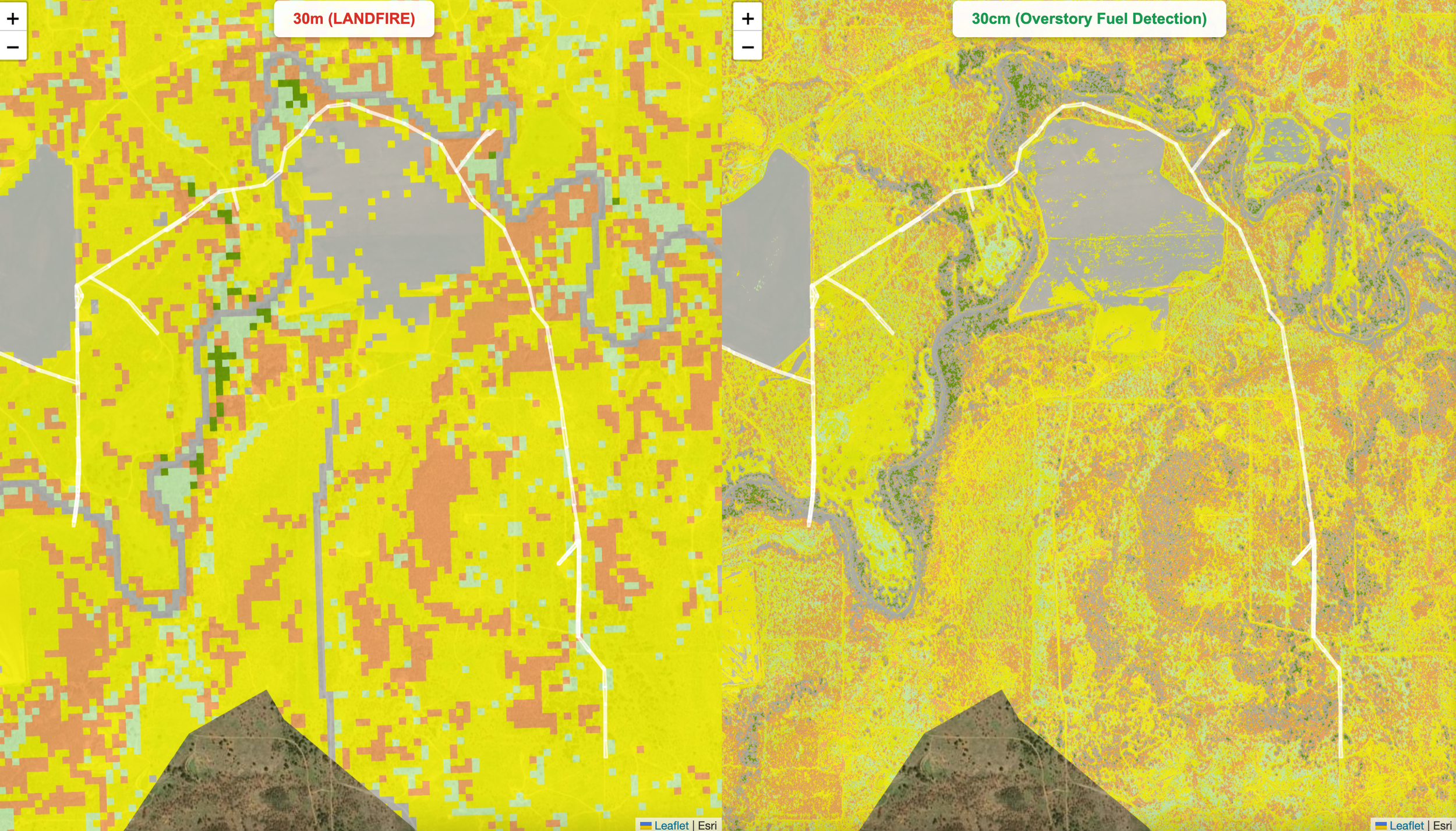
Overstory's Fuel Detection Model maps fuels at 10,000x better resolution than public landscape-scale sources.
Overstory's technology has been validated against field inspection. At a West Coast utility, it matched inspectors more than 99% of the time on high fire risk spans marked as needing no work. Certified utility foresters at a Western utility also confirmed 90% of the spans Overstory flagged as high-risk. A federal land manager choosing which acres to treat first faces the same question at a larger scale, with coarser data.
Solving the data gap between agencies and utilities
Better measurement only helps if the people working the same land can share it. The clearest demand at the event was for coordination across agencies, utilities, and vendors that assess the same corridors from different data. Both versions of FOFA address this gap. H.R. 471 would establish an interagency Fireshed Center with a public fireshed registry of geospatial data, and S. 1462 would create a Wildfire Intelligence Center. For utilities, the test for either center will be whether it can work at the resolution of a right-of-way as well as at the scale of a fireshed.
What comes next for federal wildfire policy
A Senate floor vote on S. 1462 would put the hazard-tree and permitting provisions within reach of becoming law. Neither bill specifies how anyone will show which treatments reduced the most risk. At the scale of a utility corridor, that measurement already exists, and it is the work Overstory is built to do.
For how wildfire leaders at PG&E, Holy Cross Energy, and PacifiCorp are closing that gap on their own networks, read our newest industry playbook, Three Shifts Transforming Wildfire Programs.
If your corridors cross federal land and you need help preparing for these provisions in your wildfire mitigation plan, connect with our team.
